The Isle of Man, fort by fort.
From Iron Age hillforts and promontory forts to Castle Rushen, Peel Castle and a Tudor fort: who built them and when, how they worked, and the open questions. Every fact is checked against Manx National Heritage, Visit IOM, two 2002 papers from the Scottish Society for Northern Studies and other sources, and where sources disagree we show each one.
The short version
It sits in the middle of the Irish Sea, between England, Scotland, Ireland and Wales. Manx National Heritage: About the Isle of Man The island has a 10,000-year history, with a strong Celtic and Viking past. Manx National Heritage: About the Isle of Man
Iron Age sites on the island include the hillforts at South Barrule and Cronk Sumark and the coastal forts of Cronk ny Merriu, Close ny Chollagh and Burroo Ned. Manx National Heritage (archived gov.im page, 2012): Celtic Farmers, Iron Age
Castle Rushen in Castletown is one of the best-preserved medieval castles in the British Isles. Manx National Heritage: Castle Rushen Peel Castle stands on St Patrick’s Isle, joined to Peel by a causeway. Visit IOM: Peel Castle
Andrew Johnson suggests the reused forts were lookout posts in a coastal watch called the Watch and Ward. Andrew Johnson, “Watch and Ward on the Isle of Man” (Scottish Society for Northern Studies, 2002)
Start exploring
A castle built in stages
The first stage, around 1200, was a great tower inside a ditch. Manx National Heritage: Castle Rushen Assessment of Significance (2017), on Planning Portal IoM In the 1330s and 1340s the tower was raised and towers were added to the south, west and east. Manx National Heritage: Castle Rushen Assessment of Significance (2017), on Planning Portal IoM From the 1360s to the 1390s came the curtain wall, gatehouse, barbican and a new ditch. Manx National Heritage: Castle Rushen Assessment of Significance (2017), on Planning Portal IoM
And a castle on an island
It is the biggest and most complex heritage site on the island, inside a 700-metre curtain wall. Manx National Heritage: Peel Castle Inside are almost two hectares of fortifications built over 700 years, with a cathedral, a church, chapels and graveyards. Manx National Heritage: Peel Castle More on the places to see.
Enjoying the castles and forts? Help keep the lights on.
This site is hand-built, fact-checked and free to read. If a fact, a game or one of Useless’s notes made you smile, a little support keeps it going and helps the network grow.
Isle of Man castles & forts printables
Fact-checked PDFs in A4 and US Letter, for KS2 classrooms, ages 11 to 14, families and visitors to the island’s castles and forts.
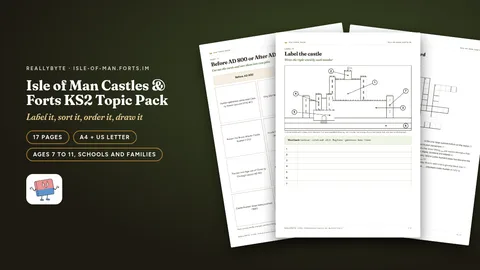
Isle of Man Castles & Forts KS2 Topic Pack
Ages 7 to 11, schools and families
Label a castle, before-or-after-the-Vikings sorting cards, put-it-in-order date cards, a true-or-false quiz, a crossword where every answer is a real fact, a word search, a comic strip, a roundhouse to colour, a certificate and a full answer key
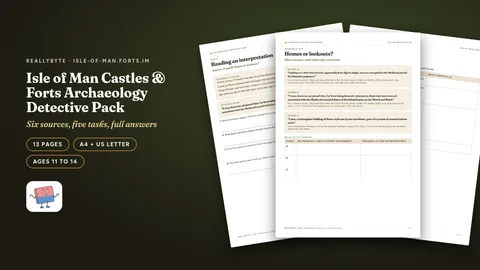
Isle of Man Castles & Forts Archaeology Detective Pack
Ages 11 to 14
Watch and Ward: were old promontory forts reused as lookout posts? Short sources with their provenance, an evidence table, questions experts still cannot answer, and a judgement task, with full answers
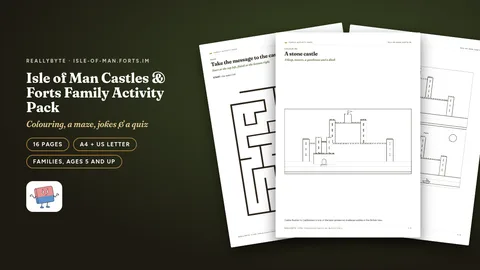
Isle of Man Castles & Forts Family Activity Pack
Families, ages 5 and up
Colouring pages, a castle maze, spot-the-difference, design your own castle, Useless the Eraser’s castle jokes and a 20-question quiz to do together
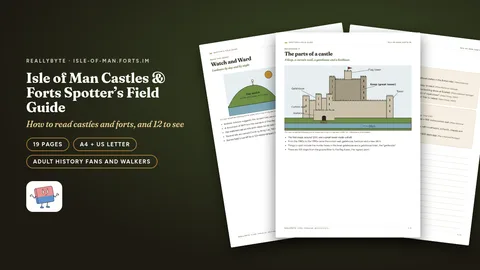
Isle of Man Castles & Forts Spotter’s Field Guide
Adult history fans and walkers
How to read castles and promontory forts, how Castle Rushen grew, the Watch and Ward, roundhouses and longhouses, 12 places around the island with what the people who look after or study them say, a timeline, open questions and a checklist
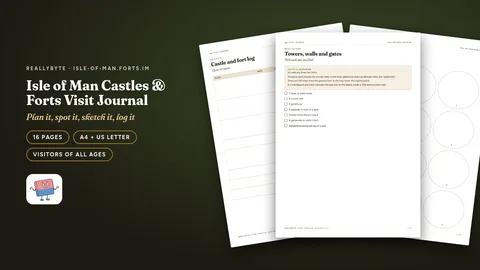
Isle of Man Castles & Forts Visit Journal
Visitors of all ages
Before-you-go checklist, what-to-spot tick lists for towers, walls, gates, banks, ditches and homes, six sketch pages, a log for up to 12 visits, and a visit stamps page
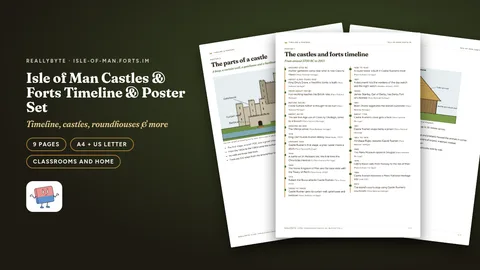
Isle of Man Castles & Forts Timeline & Poster Set
Classrooms and home
Six poster pages: a timeline from 5700 BC to 2013, the parts of a castle, how Castle Rushen grew, life in a roundhouse, forts around the island, and the island in numbers
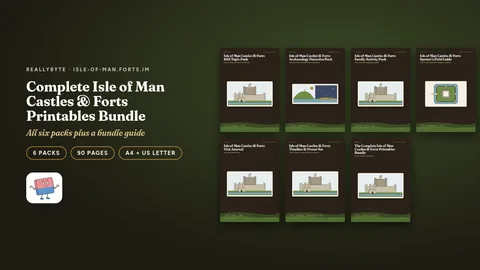 Best value
The Complete Isle of Man Castles & Forts Printables Bundle
All six packs plus a bundle guide, A4 and US Letter, in one download. $12.99 instead of $26.44 bought separately.